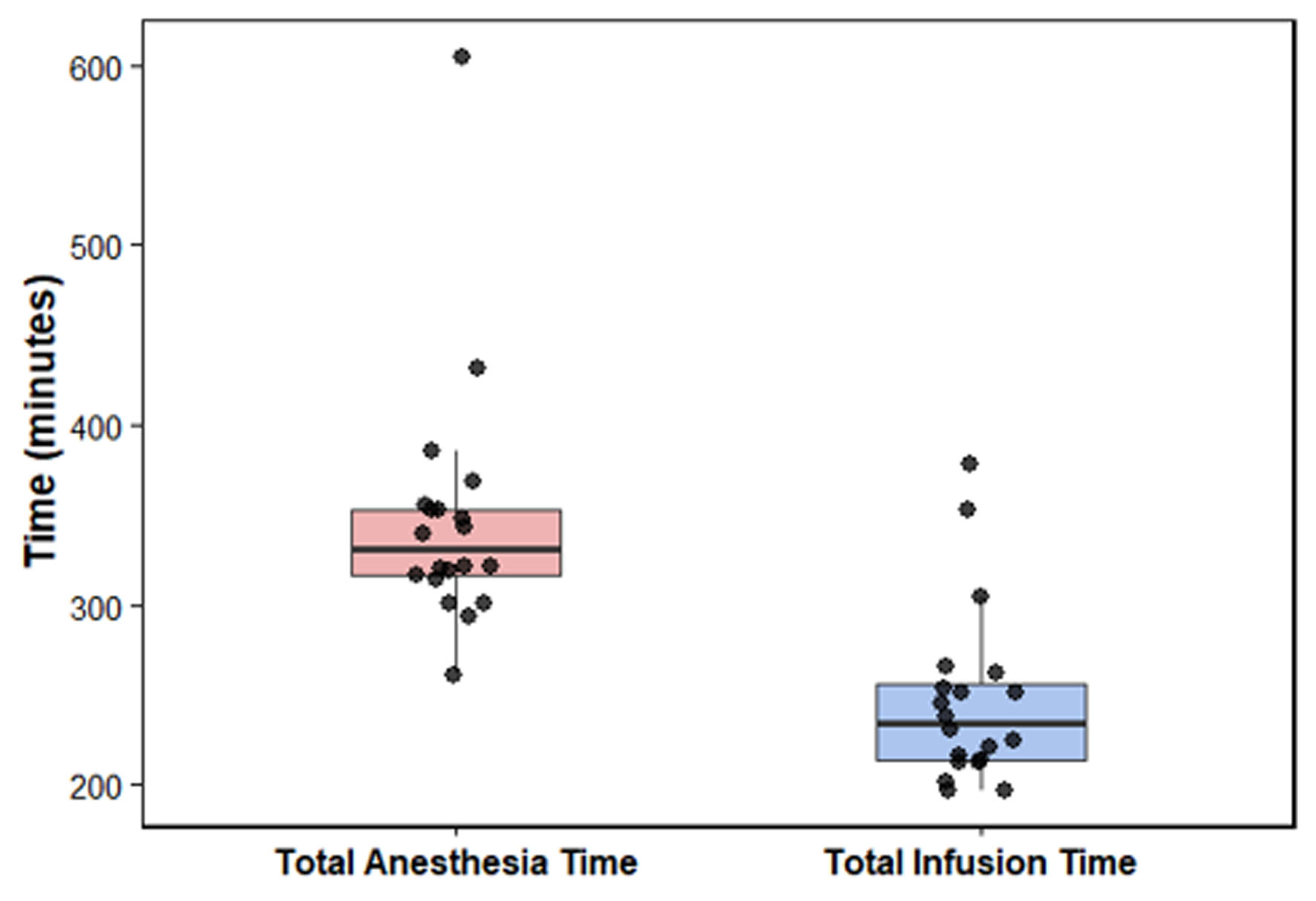
↓ Figure 1. Distribution of total anesthesia duration and remimazolam infusion duration in the 20-patient study cohort. Individual points represent patients, boxes represent the interquartile ranges, and horizontal lines represent medians.
| Journal of Current Pharmacology, ISSN NoIssnPrint print, 0000-0000 online, Open Access |
| Article copyright, the authors; Journal compilation copyright, J Curr Pharmacol and Elmer Press Inc |
| Journal website https://jcp.elmerpub.com |
Original Article
Volume 1, 2026, e6
Flumazenil Reversal of Remimazolam Sedation to Facilitate Emergence and Rapid Neurologic Examination in Patients Undergoing Posterior Spinal Fusion
Figures
Tables
| BIS: Bispectral Index; MAP: mean arterial pressure; MEP: motor evoked potential; SSEP: somatosensory evoked potential. |
| Preoperative care: |
| 1. Aprepitant (1 mg/kg PO to a maximum of 40 mg). |
| 2. Gabapentin (5 mg/kg to a maximum of 300 mg). |
| 3. Oral or intravenous midazolam as needed. |
| Intraoperative care |
| 1. Inhalation induction with sevoflurane or nitrous oxide of IV placement |
| 2. Induction of anesthesia |
| a. Fentanyl 2–3 µg/kg |
| b. Methadone 0.1–0.15 mg/kg (maximum 10 mg) |
| c. Rocuronium 0.2–0.4 mg/kg for endotracheal intubation |
| 3. Placement of two peripheral IVs and arterial cannula |
| 4. Dexamethasone (0.25 mg/kg up to 8 mg) |
| 5. Surgical site infection prophylaxis with cefazolin every 3 h |
| 6. Tranexamic acid: 50 mg/kg followed by 5 mg/kg/h |
| 7. Maintenance anesthesia with propofol + remifentanil |
| a. Adjust propofol infusion to maintain the BIS at 50–60 |
| b. Remimazolam at 10 µg/kg/min. Once remimazolam is started, decrease propofol based on a BIS at 50–60 |
| 8. Adjust remifentanil from 0.1 to 0.5 µg/kg/min to maintain the mean arterial pressure at 50–65 mm Hg |
| 9. Clevidipine 1–5 µg/kg/min to keep MAP at 50–65 mm Hg if needed during dissection and osteotomies |
| 10. Following rod placement and distraction will need phenylephrine to increase MAP to 65–85 mm Hg |
| Decrease remimazolam infusion to 5 µg/kg/min after placement of first rod. |
| 12. Once second rod is in place and final distraction obtained, obtain last set of neurophysiologic monitoring (MEP and SSEP). Discontinue propofol and remimazolam. |
| 13. Desflurane as needed to maintain BIS at 50–60 |
| 14. Titrate hydromorphone based on respiratory rate to provide postoperative analgesia. |
| 15. After instrumentation, phenylephrine as needed to maintain MAP. |
| 16. Acetaminophen 15 mg/kg (maximum 1,000 mg) and ketorolac (0.5 mg/kg to a maximum of 15 mg). |
| 17. Prophylaxis for postoperative nausea and vomiting with ondansetron 0.15 mg/kg (maximum 4 mg) and dexamethasone (0.25 mg/kg up to 4 mg) |
| 18. After completion of surgical procedure and turning supine, incremental doses of flumazenil (0.1–0.2 mg) as needed to facilitate emergence |
| Characteristics | Frequency (%) or median (IQR) |
|---|---|
| a“Other” race includes Asian and multiracial. bPatients may have more than one comorbid condition; therefore, percentages do not sum to 100%. ENT: ear, nose, and throat; IQR: interquartile range. | |
| Study population, n (%) | 20 (100%) |
| Age (years) | 14 (13, 16) |
| Sex | |
| Female | 17 (85%) |
| Male | 3 (15%) |
| Race and ethnicity | |
| Non-Hispanic Black/African American | 2 (10%) |
| Non-Hispanic White | 14 (70%) |
| Othera | 4 (20%) |
| Height (cm) | 160.7 (154.9, 167.2) |
| Weight (kg) | 52.9 (46.8, 60.4) |
| Comorbid conditionsb | |
| Airway/ENT | 3 (15%) |
| Gastrointestinal | 3 (15%) |
| Neurodevelopmental/psychiatric | 7 (35%) |
| Pulmonary/respiratory | 8 (40%) |
| Musculoskeletal/orthopedic | 20 (100%) |
| Other | 5 (25%) |
| Total anesthesia time (min) | 331 (315.5, 354) |
| Characteristics | Frequency (%) or median (IQR) |
|---|---|
| aThe one intraoperative concern was a change in motor evoked potentials; this patient was admitted to the ICU postoperatively for monitoring. No patients experienced bradycardia, emergence agitation, re-sedation, or emergence delirium. bTwo encounters were excluded from the peri-emergence effectiveness analysis because flumazenil was not administered within the predefined peri-extubation window. cOne encounter was excluded from remimazolam infusion stop-to-first flumazenil bolus analysis because multiple wake-up tests were performed intraoperatively. IQR: interquartile range; µg: microgram; mg: milligram; kg: kilogram; min: minutes. | |
| Were there any intraoperative concerns? | |
| No | 19 (95%) |
| Yesa | 1 (5%) |
| Starting remimazolam infusion dose (µg/kg/min) | |
| ≤ 5 | 8 (40%) |
| 10 | 11 (55%) |
| 20 | 1 (5%) |
| Maximum infusion dose of remimazolam per patient (µg/kg/min) | |
| 5 | 6 (30%) |
| 10 | 13 (65%) |
| 20 | 1 (5%) |
| Remimazolam infusion time per patient (min) | 234 (213.5, 258) |
| Total remimazolam infusion time across all patients (min) | 4,931 |
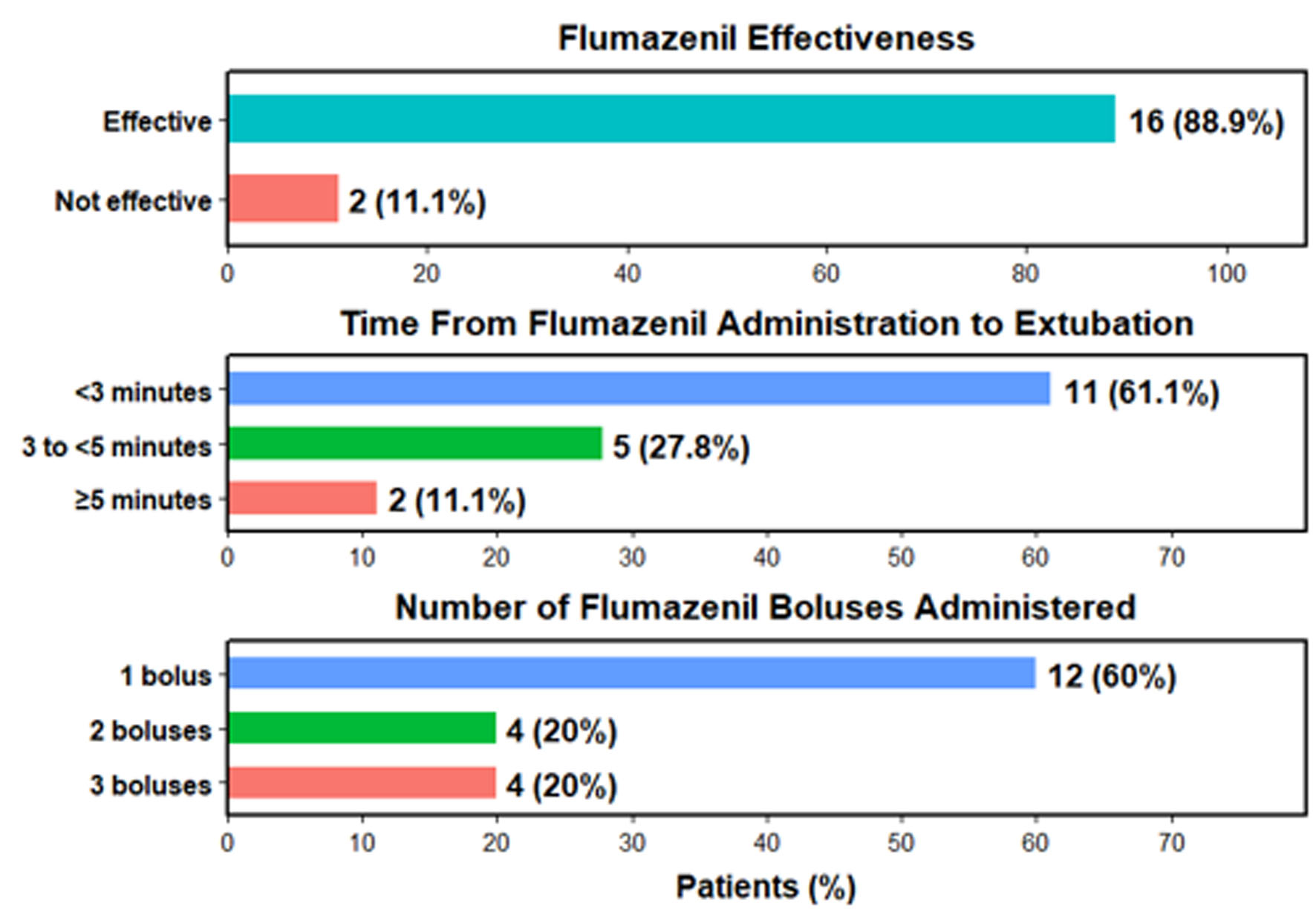
| Was flumazenil effective? | |
| No | 2 (11.1%) |
| Yes | 16 (88.9%) |
| Number of flumazenil boluses administered per patient | |
| 1 | 12 (60%) |
| 2 | 4 (20%) |
| 3 | 4 (20%) |
| Total flumazenil dose per patient (mg) | (0.1, 0.2) |
| Flumazenil administration to tracheal extubation time (min)b | |
| < 3 | 11 (61.1%) |
| ≥ 3 to < 5 | 5 (27.8%) |
| ≥ 5 | 2 (11.1%) |
| Time from remimazolam infusion stop to first flumazenil bolus (min)c | 46 (41, 50) |
| Medication | Patients receiving medication (number) |
|---|---|
| aEleven most frequently administered medications. | |
| Cefazolin | 20 |
| Methadone | 20 |
| Propofol | 20 |
| Dexamethasone | 19 |
| Phenylephrine | 18 |
| Ondansetron | 17 |
| Rocuronium | 17 |
| Remifentanil | 16 |
| Acetaminophen | 15 |
| Fentanyl | 15 |
| Lidocaine | 14 |